
Improving biodiversity, climate, and economic development together
A new paper in Science applies a novel modeling approach to 146 countries to show how strategic land use can provide significant gains for climate and nature without economic losses.
This post was adapted from the original published by the University of Minnesota.
A landmark new study published in the journal Science found that countries don't have to choose between protecting the environment and pursuing economic growth — they can achieve both at the same time, and most are currently falling well short of what's possible.
The research, conducted by an interdisciplinary team including scientists from Natural Capital Insights, analyzed land use and land management across 146 countries. Using spatial and economic data alongside optimization methods, the team mapped what each country could realistically achieve by balancing biodiversity conservation, climate mitigation, and agricultural and forestry production.
Results
The findings are striking. Across all 146 countries, there is potential to increase climate mitigation by reducing more than 200 billion metric tons of CO₂ emissions — a 20% improvement — or to boost net economic value from land use by over $350 billion (an 80% increase), without sacrificing progress on other goals. These gains can come from smarter land reallocation, such as targeted forest restoration, and from improving crop yields in lower-income countries where agriculture is currently less productive.
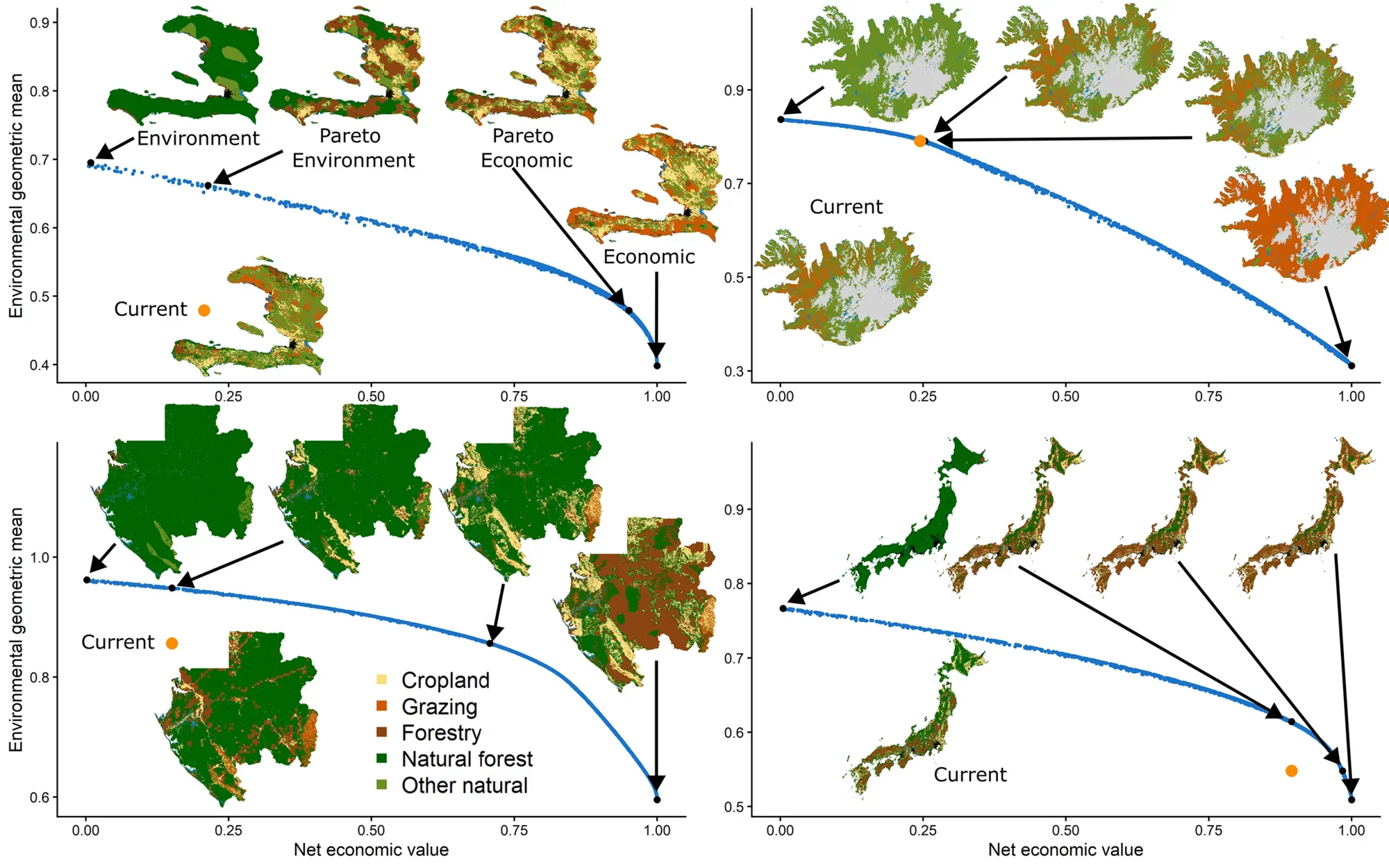
Sustainable landscape efficiency frontiers and current performance, showing potential simultaneous gains for environmental and economic outcomes and tradeoffs for illustrative countries: (A) Haiti, (B) Iceland, (C) Gabon, and (D) Japan. The horizontal axis measures net economic value from agricultural crop production, livestock grazing, and forestry. The vertical axis is the geometric mean of climate mitigation and biodiversity scores.
"This research proves that the supposed tradeoff between protecting nature and growing economies is false," said Becky Chaplin-Kramer, co-author and global biodiversity lead scientist at World Wildlife Fund-US. "By mapping what's truly possible country by country, we've given policymakers and investors a roadmap to pursue biodiversity gains, climate mitigation, and development goals together."
Impact
The research is already being put to use. NatCap Insights and its partners, including the World Bank, are applying the findings through country-specific analyses to help direct investment and policy in ways that meet both national development goals and international climate and biodiversity commitments.
Funding for the analysis was provided by the Gordon and Betty Moore Foundation, the University of Minnesota Fesler-Lampert Endowment, the University of Minnesota Institute on the Environment, World Resources Institute, and the World Bank.